BTS Arirang Meaning in English and Why This Album Title Changes Everything | On March 20 2026 BTS will release their fifth studio album titled Arirang. The announcement sent millions of fans around the world searching for one thing. What does BTS Arirang meaning in English actually convey. The answer takes us on a journey through centuries of Korean history and deep into the emotional core of what makes BTS who they are.
Arirang is not just a song title. It is widely considered the unofficial national anthem of Korea. UNESCO inscribed it on the Representative List of the Intangible Cultural Heritage of Humanity in 2012 recognizing it as a powerful symbol of Korean identity. The fact that BTS chose this name for their comeback album after completing military service speaks volumes about the message they want to deliver.
The traditional folk song has existed for centuries in countless regional variations. Its melody is simple yet haunting. Its lyrics carry themes of separation and longing and resilience. For Koreans the word Arirang alone can bring tears or ignite fierce pride. Understanding this cultural weight is essential to grasping why this album matters far beyond pop music.
In this article we will break down the full English translation of the Arirang lyrics. We will explore the cultural and historical significance of the song. And we will examine how BTS has woven this centuries-old tradition into a bold statement about their identity as Korean artists on the global stage.


Understanding BTS Arirang Meaning in English Through the Original Lyrics
The Core Verses That Every Korean Knows
The traditional Arirang lyrics are deceptively short. The base version that most Koreans recognize contains just four lines. In Korean the opening goes 아리랑 아리랑 아라리요 followed by 아리랑 고개로 넘어간다. In English this translates roughly to Arirang arirang arariyo and you are crossing over Arirang Pass.
The second couplet reads 나를 버리고 가시는 님은 and 십리도 못가서 발병난다. Translated into English this means if you leave me behind your feet will grow sore before you have gone ten ri. Ten ri is an ancient Korean unit of measurement equal to roughly four kilometers or about two and a half miles.
The Deeper Emotional Layer Behind the Words
At first glance these lyrics might seem like a simple curse directed at a departing lover. But the meaning runs much deeper. The speaker has endured so much for the sake of the person leaving that the emotional weight of that departure will be physically unbearable. The pain will stop the leaver in their tracks before they have barely begun their journey.
This is not a song of bitter revenge. It is a song of anticipated reckoning and heartfelt loss. The speaker acknowledges the departure while expressing that the bond between them is so deep that walking away will carry consequences the leaver cannot escape. This duality of grief and strength is central to understanding BTS Arirang meaning in English.

The Cultural Weight of Arirang and BTS Arirang Meaning in English
Arirang and the Korean Concept of Han
To truly understand BTS Arirang meaning in English you must understand a uniquely Korean concept called han. Han refers to a deep collective sense of sorrow and endurance shaped by centuries of hardship. It is not passive sadness. It is suffering born of tremendous effort to overcome.
Han carries the accumulated weight of historical trauma suspended in the gravity of Korean resilience. It connects individual pain to the collective Korean experience. Arirang is one of the purest expressions of han in Korean culture. When a Korean person hears the melody they feel a connection to every generation that has sung it before them.
How Arirang Became a Symbol of Resistance
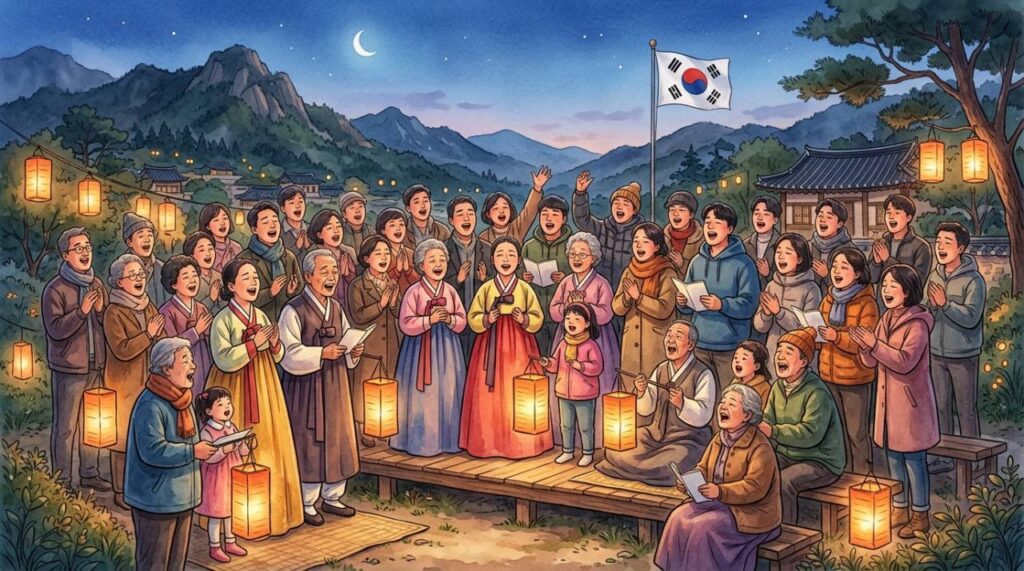
During the Japanese occupation of Korea from 1910 to 1945 Korean language and culture were systematically suppressed. Patriotic songs were banned. But Arirang slipped through. It was a folk song with no explicitly political lyrics. Yet every Korean who sang it understood its true meaning. It became an anthem of cultural resistance hummed by refugees and soldiers and families torn apart by war.
After the division of Korea in the mid twentieth century the song continued to serve as a symbol of shared heritage transcending the ideological border between North and South Korea. Both nations inscribed their versions of Arirang on the UNESCO heritage list. In South Korea it was sung at pro-democracy demonstrations. In North Korea it lent its name to the massive Arirang Mass Games.
Why BTS Named Their 2026 Album Arirang and What It Means in English
A Deliberate Statement of Korean Identity
Big Hit Music stated that the album title captures BTS identity as a group that began in Korea. After years of global superstardom with English-language singles and Western collaborations the choice to name their comeback album after the most Korean song in existence is a profound declaration. BTS is saying this is where we come from and this is who we are.
The album arrives after each member completed mandatory South Korean military service. The last member was discharged in June 2025. This shared experience of national duty followed by a collective return mirrors the themes of separation and reunion that define the Arirang folk song itself.
The 1896 Connection That Makes It Even More Powerful
The animated trailer for the album draws on a remarkable piece of history. In 1896 seven young Korean students at Howard University in Washington D.C. made what is believed to be the earliest audio recording of Arirang. These students were studying abroad during a period when Korea was caught between competing imperial powers and losing its sovereignty.
BTS reimagined this story in their trailer. Seven Korean students in 1896 preserving their culture while far from home. Seven BTS members in 2026 carrying Korean culture to the world stage. The parallel spans one hundred and thirty years and draws a direct line between past and present. The album cover reinforces this connection showing all seven members in formal suits evoking early twentieth century portrait photography.

BTS Arirang Meaning in English and the Album Tracklist Explained
Fourteen Tracks That Tell a Complete Story
The Arirang album contains fourteen tracks. It opens with Body to Body and moves through Hooligan and Aliens and FYA. The sixth track No. 29 serves as an interlude. The lead single Swim sits at the seventh position and is described as an upbeat alternative pop song about continuing to move forward through life’s waves without stopping.
The second half features Merry Go Round and Normal and Like Animals and They Don’t Know Bout Us. The album closes with One More Night and Please and finally Into the Sun. RM is credited as a writer on every track except the interlude demonstrating his central role in the creative direction.
The Lead Single Swim and Its Connection to BTS Arirang Meaning in English
The title track Swim centers on the resolve to keep moving forward despite turbulent waves. Rather than resisting the current the song frames the choice to move ahead at your own pace as an expression of love for life itself. This connects directly to the spirit of Arirang where endurance and forward movement through pain define the emotional core.
Fans have noted the connection to Sea from the Love Yourself Her album which used the ocean as a metaphor for fame. While the two songs may differ musically they share aquatic imagery that represents the unpredictable nature of life and the courage required to keep swimming.

Historical Context Behind BTS Arirang Meaning in English
Korea in 1896 When Arirang Was First Recorded
The seven Korean students who recorded Arirang in Washington were living through a period of immense national crisis. Japan had recently defeated China in the First Sino-Japanese War fought largely over control of the Korean peninsula. King Gojong had fled to the Russian legation in Seoul following the assassination of Queen Min by Japanese agents.
For these young men far from home singing Arirang into a recording device was an act of cultural preservation. The wax cylinder recordings they made predated widespread phonograph use in Korea itself. Their voices carrying the melody of Arirang across an ocean and into the future became an unlikely but crucial preservation effort.
The 1926 Film That Made Arirang a National Symbol
The version of Arirang most widely recognized today known as Bonjo Arirang or Standard Arirang was popularized through the 1926 silent film of the same name. The film told a story of colonial oppression and resistance and its theme song swept across the peninsula. This was the moment Arirang transformed from a regional folk song into the emotional anthem of an entire nation.
Experts estimate that approximately three thousand six hundred variations of Arirang exist belonging to about sixty distinct versions. Each region of Korea added its own verses and melodies reflecting local experiences and metaphors. This endless adaptability is part of what makes the song so enduring and so perfect as the title for a BTS album that spans multiple genres and emotions.

How BTS Arirang Meaning in English Resonates with Global ARMY
A Bridge Between Korean Heritage and Global Fandom
For international fans who do not speak Korean the album title Arirang might initially seem unfamiliar. But BTS has always been intentional about educating their audience on Korean culture. By choosing this title they invite millions of fans worldwide to learn about the folk song and through it gain a deeper understanding of Korean identity and history.
The Google scavenger hunt launched on March 4 as part of the album promotion included trivia questions about Korean culture and BTS history. Searching for BTS on Google triggered a graphic of a blue ship in a bottle which led to handwritten song titles by the members. These interactive experiences helped global fans connect with the cultural context of the album.
Why ARMY Responded with Tears
When the album title was first announced on January 15 2026 Korean fans responded with overwhelming emotion. The word Arirang carries so much cultural weight that simply naming an album after it felt like a declaration of love for Korea itself. Many fans shared personal stories about what the folk song meant to their families.
One blogger described asking her Korean parents what Arirang meant to them. Her mother responded with a long contemplative sigh and said it is our heart. It is our temperament. Her father simply said han. These deeply personal reactions illustrate why the BTS Arirang meaning in English cannot be captured by translation alone. It must be felt.

The BTS Arirang Meaning in English Through Producers and Collaborators
World-Class Production Meets Korean Soul
The album features an impressive roster of international collaborators. Ryan Tedder of OneRepublic called it one of the craziest things he has worked on in his whole career. Kevin Parker of Tame Impala contributed to Merry Go Round. Diplo worked on multiple tracks and called it the craziest album ever. JPEGMAFIA and Flume and Mike WiLL Made It also appear in the credits.
Yet despite this global production team the album remains anchored in Korean identity. Pdogg the longtime BTS producer is credited on numerous tracks. The animated trailer features an original Arirang arrangement by Goldbranch performed on piano. The fusion of international production talent with deeply Korean themes embodies the same cultural bridge that BTS has been building throughout their career.
Recording in Los Angeles With Korean Hearts
The group spent time in Los Angeles during 2025 working on the album. They collaborated closely with producers and songwriters while channeling their experiences from military service and the three year hiatus into the music. According to Big Hit Music each member had a hand in steering the creative direction and anchoring each song in raw emotion.
This is the longest BTS has been inactive as a group since their 2013 debut. The fact that they returned with an album named after the most emotionally charged song in Korean culture tells us everything about their mindset. They did not come back to chase trends. They came back to make a statement about who they are.

BTS Arirang Meaning in English and the Upcoming World Tour
Eighty-Two Shows Across Thirty-Four Cities
The Arirang World Tour begins on April 9 2026 in Goyang South Korea and will run through March 2027. With eighty-two shows across thirty-four cities it will be the largest world tour ever mounted by a South Korean act. All announced shows sold out within hours of tickets going on sale.
The day after the album release on March 21 BTS will hold a comeback concert called BTS The Comeback Live Arirang at Gwanghwamun Square in Seoul. This performance will be exclusively streamed on Netflix. A behind-the-scenes documentary titled BTS The Return will premiere on Netflix on March 27 offering intimate access to the album creation process.
Why Gwanghwamun Square Matters
The choice of Gwanghwamun Square for the comeback concert is symbolically significant. Gwanghwamun is the main gate of Gyeongbokgung Palace the primary royal palace of the Joseon Dynasty. It sits at the heart of Seoul representing Korean history and sovereignty. Performing there connects the Arirang album to the physical landscape of Korean heritage in a way that no other venue could.

Final Thoughts on BTS Arirang Meaning in English
The BTS Arirang meaning in English extends far beyond a simple translation. It encompasses centuries of Korean history and the concept of han and the resilience of a culture that has endured colonization and division and rapid modernization. When BTS chose Arirang as their album title they were not simply picking a name. They were claiming their place in a lineage of Korean cultural expression that stretches back hundreds of years.
Seven students in 1896 sang Arirang into a recording device in Washington D.C. preserving Korean voices during a time of national crisis. Seven members of BTS in 2026 carry that same spirit to stadiums across the world. The melody endures. The meaning deepens. And through this album the BTS Arirang meaning in English becomes a bridge connecting the past to the present and Korea to the world.

For more detailed information about the Arirang folk song visit the UNESCO Intangible Cultural Heritage page and the Britannica entry on Arirang. To learn about the 1896 Korean students at Howard University read the Boundary Stones article on the history. For the full album tracklist and credits see the Wikipedia article on Arirang album.